ROYAL NAVY SOUTH ATLANTIC COMMAND - ROYAL NAVY H
2)HAWKINS (HEAVY CRUISER)
Image by A. I.

Completed: 1919
Displacement: 12,190 tons (full load)
Length: 605 ft
Beam: 65 ft
Draught: 20,5 ft (full load)
Propulsion: Eight Yarrow-type oil-fired water-tube boilers, Two coal fired boilers (until 1929 - then ten oil fired boilers), Parsons geared steam turbines, Four shafts, 60,000 shp
Range: 5,400 miles at 14 kts
Armament: 7 x BL 7.5 inch Mark VI in single mounts CP Mk.V, 4 x QF 12 pdr 20 cwt Mk.I on single mounts HA Mk.II, 4 x QF 12 pdr 20 cwt Mk.I on single mounts HA Mk.II, 2 x QF 2 pdr Mk.II on single mounts HA Mk.I, 2 x submerged & 4 x fixed above water 21 inch torpedo tubes
Speed: 30 kts
Complement: 800
During World War II, the heavy cruiser HMS Hawkins (D86) played a crucial role in safeguarding Allied supply lines in the South Atlantic Station. Re-commissioned and re-armed at the start of the conflict, the veteran warship was assigned to the South Atlantic Division between 1940 and early 1941 to counter German naval threats.
Key Strategic Operations in the South Atlantic:
Hunting Axis Surface Raiders: Her primary strategic objective was patrolling deep-water chokepoints to hunt down and intercept German commerce raiders and disguised auxiliary cruisers trying to break out into the Atlantic or slip around Cape Horn.
Blockade Duties and South American Patrols: Operating extensively off the eastern coast of South America, HMS Hawkins monitored axis shipping and enforced naval blockades. Her patrols regularly took her as far south as the Falkland Islands and into key diplomatic ports like Montevideo, Uruguay.
Troopship Escort Force: She served as an essential ocean escort for highly targeted military troopship convoys. According to historical timelines on Naval-History.Net, her duties peaked during deployments such as:
Convoy WS.5B: In December 1940, she joined the heavy cruiser HMS Devonshire to provide continuous defense for troopships transiting from Freetown down to Durban.
Convoy WS.5A: In January 1941, she partnered with the cruiser HMS Norfolk to shield outbound personnel convoys leaving the Freetown naval hub.
Following her extensive service securing the South Atlantic sea lanes, she sailed to Simonstown, South Africa, for maintenance before being officially transferred to the East Indies Squadron to support campaigns in the Indian Ocean.
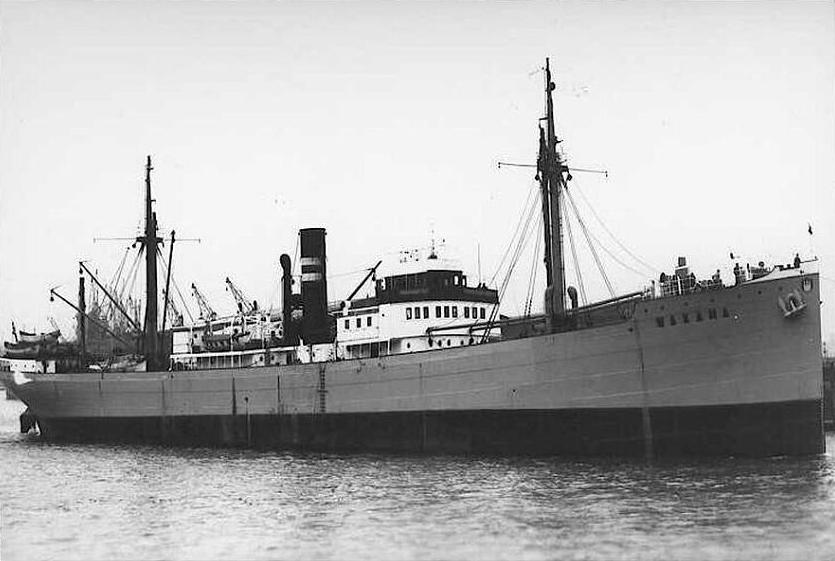
On 12/Feb/40 German Merchant Wakama before an imminent capture by HMS cruiser Hawkins and HMS Dorsetshire, was scuttled by own crew off Rio de Janeiro on position 22º 35’S 41º 39’W. 46 survivors were taken as POW.
On 5 September 1940 HMS Hawkins sailed to Simonstown, South Africa for a refit. Before she could make use of the dry dock, it was occupied by the aircraft carrier HMS Hermes, which was undergoing repairs after having been damaged in a collision with a merchant ship. Hawkins was diverted to Durban where she spent seven weeks waiting before she was able to dock in the Selborne dry dock at Simonstown.

On 6 Jan 41 Hawkins also rescued nine of the crew from the tanker SS British Premier, seen below, which had been torpedoed off Freetown by U-65 in pos. 06º 20’N 13º 20’W on 24/12/1940.